The Pentagon UAP Videos, Explained
How three short infrared clips recorded by U.S. Navy fighters became the first military UAP footage the Pentagon formally acknowledged on the record — and what 'unidentified' actually means.
On 27 April 2020, the United States Department of Defense officially declassified and released three short infrared video clips recorded by U.S. Navy fighter aircraft. Known by the callsigns FLIR1, GIMBAL, and GO FAST, the recordings were the first military UAP footage the U.S. government formally acknowledged as authentic. The Pentagon confirmed that the objects shown were "unidentified" — a designation that matters far more than the speculation it spawned.
The 2004 Nimitz Encounter (FLIR1)
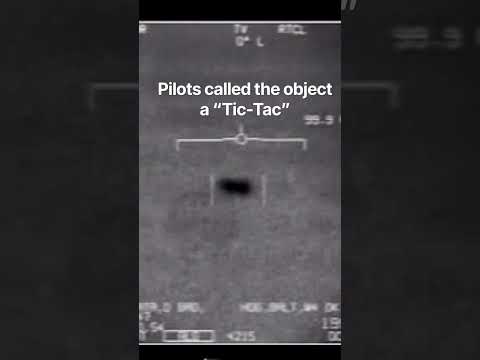
On 14 November 2004, the USS Nimitz Carrier Strike Group was operating in training waters off the coast of southern California. For days, the SPY-1 radar aboard the cruiser USS Princeton had been tracking anomalous aerial tracks that appeared, descended from high altitude, and vanished. An F/A-18F Super Hornet crewed by Commander David Fravor and Lieutenant Commander Jim Slaight was vectored to intercept. At the location, they found a disturbed patch of churning ocean roughly the size of a Boeing 737 with no vessel beneath it, and hovering some fifty feet above the water, a smooth white object about forty feet long — no wings, no control surfaces, no visible exhaust — that witnesses described as resembling a Tic Tac.
When Fravor descended to investigate, the object appeared to mirror his turn, then climbed rapidly and accelerated away at a speed the aircrew estimated the F/A-18 could not match. The brief infrared clip later labeled FLIR1 was recorded by a second F/A-18 launched to chase the contact; it shows a dark, pill-shaped object tracked against a bright ocean background, with no obvious flight surfaces or propulsion signature.
The footage emerged into public discussion by 2007 and was widely circulated by the organization To The Stars Academy in December 2017. It was not officially declassified until the Pentagon's April 2020 release.
GIMBAL and GO FAST (2015)
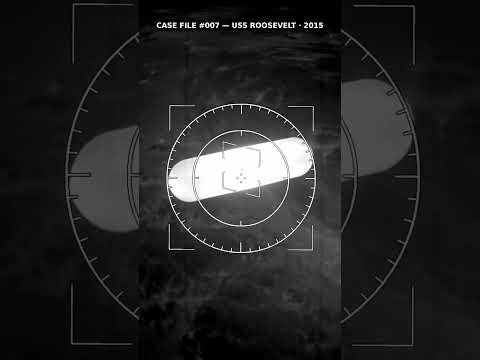
The other two clips were recorded in 2015 by F/A-18 fighters from the USS Theodore Roosevelt Carrier Strike Group, operating along the U.S. southeastern seaboard. Both were captured by an ATFLIR targeting pod — the same advanced infrared sensor system used for the Nimitz recording.
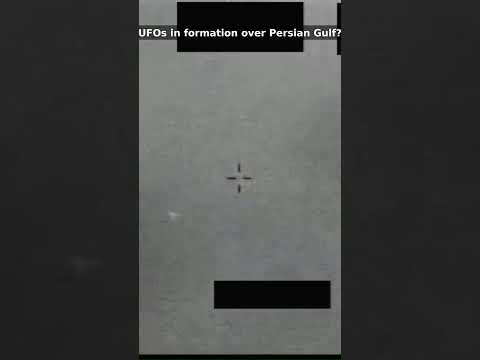
The clip known as GIMBAL shows a dark object against a horizon with an apparent rotation of its long axis at the end of a banking maneuver; over the radio, one pilot remarks, "There's a whole fleet of them." The GO FAST clip shows an object at relatively low altitude tracked by the pod's infrared camera, with the aircrew debating whether it is actually moving quickly or simply appears to.
All three videos are short — roughly a minute to a minute and a half each — and were recorded under operational conditions, without any expectation of encountering anything unusual.
What "unidentified" actually means
In its April 2020 statement, the Department of Defense was deliberately precise: after review, the aerial phenomena in the videos "could not be identified." The Pentagon did not state what the objects are, only that its analysts could not determine what they were from the available footage and sensor data.
That distinction is the whole point, and it is often missed. "Unidentified" is not a synonym for "alien," "interstellar," or "impossible." It is a label of honest uncertainty — the statement that the observed motion, signature, and behavior did not match any aircraft, drone, balloon, or natural phenomenon that the reviewing analysts could match it to.
In the years since release, independent analysts have proposed conventional explanations for portions of each clip — that the apparent rotation in GIMBAL may reflect the camera's gimbal mechanism rather than the object, and that the apparent speed in GO FAST may be partly an artifact of parallax against a distant background. The Navy has nonetheless retained the UAP designation, and the clips remain the most extensively studied military UAP footage in the public record.
Why these recordings matter
The Pentagon videos marked a genuine shift in how governments talk about this subject. Within a few years, the U.S. Navy established formal reporting guidelines for UAP encounters, the Department of Defense stood up what eventually became the All-domain Anomaly Resolution Office (AARO), and NASA commissioned an independent UAP study. Other governments have moved toward similar transparency.
For an archive like this one, the videos are a useful reference point: they demonstrate what high-credibility, multi-sensor UAP evidence actually looks like, and they establish a baseline against which civilian sightings can be compared. The objects in FLIR1, GIMBAL, and GO FAST may or may not ever be explained. What is no longer in question is that they were recorded on U.S. military sensors, that the Pentagon has said so on the record, and that the footage is real.
Related Records in the Archive
More in Government & Military
Brazil's National UFO Files: What the Declassification of Nearly 900 Cases Confirms
Brazil's National Archives has declassified nearly 900 — by some counts 972 — previously classified UFO documents, reportedly confirming a formal government UFO program and shedding new light on cases like the 1986 'Official UFO Night' and the 1996 Varginha incident.
From Project Sign to AARO: A Timeline of U.S. Government UFO Investigation
Seventy-five years of official American interest in UFOs, from Project Sign in 1948 to the modern All-domain Anomaly Resolution Office — a chronology of the institutional record.
Project Blue Book: The Air Force and Twenty-Two Years of UFO Investigation
From 1947 to 1969 the U.S. Air Force investigated more than twelve thousand UFO reports under Sign, Grudge, and Blue Book — the largest formal government study until the modern UAP era.